
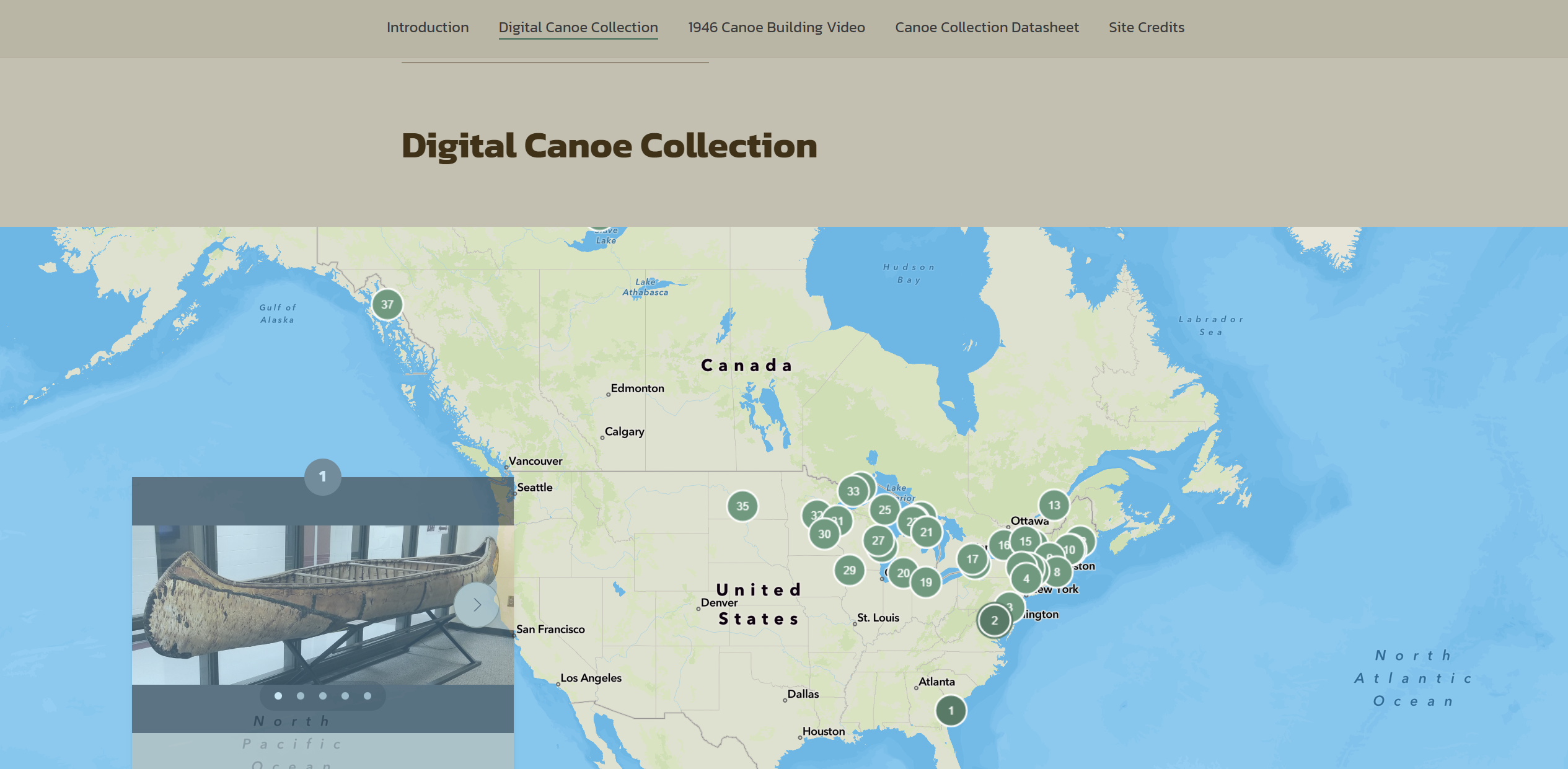
The website named “Bark Canoes” is about how native Americans made canoes and the different types of canoes. The native Americans made canoes to travel on the great lakes, oceans, and rivers around North America, especially the northeast United States and southeast Canada. This website serves a purpose to many people, researchers, students, and people interested in the canoes. The way the website is set up, it is a long block of text across the left side of the screen, slightly indented, overlaid on a stagnant map throughout the entire site, barring the introduction.
https://storymaps.arcgis.com/stories/899023e31da6401dae2bb50ebecbdff8
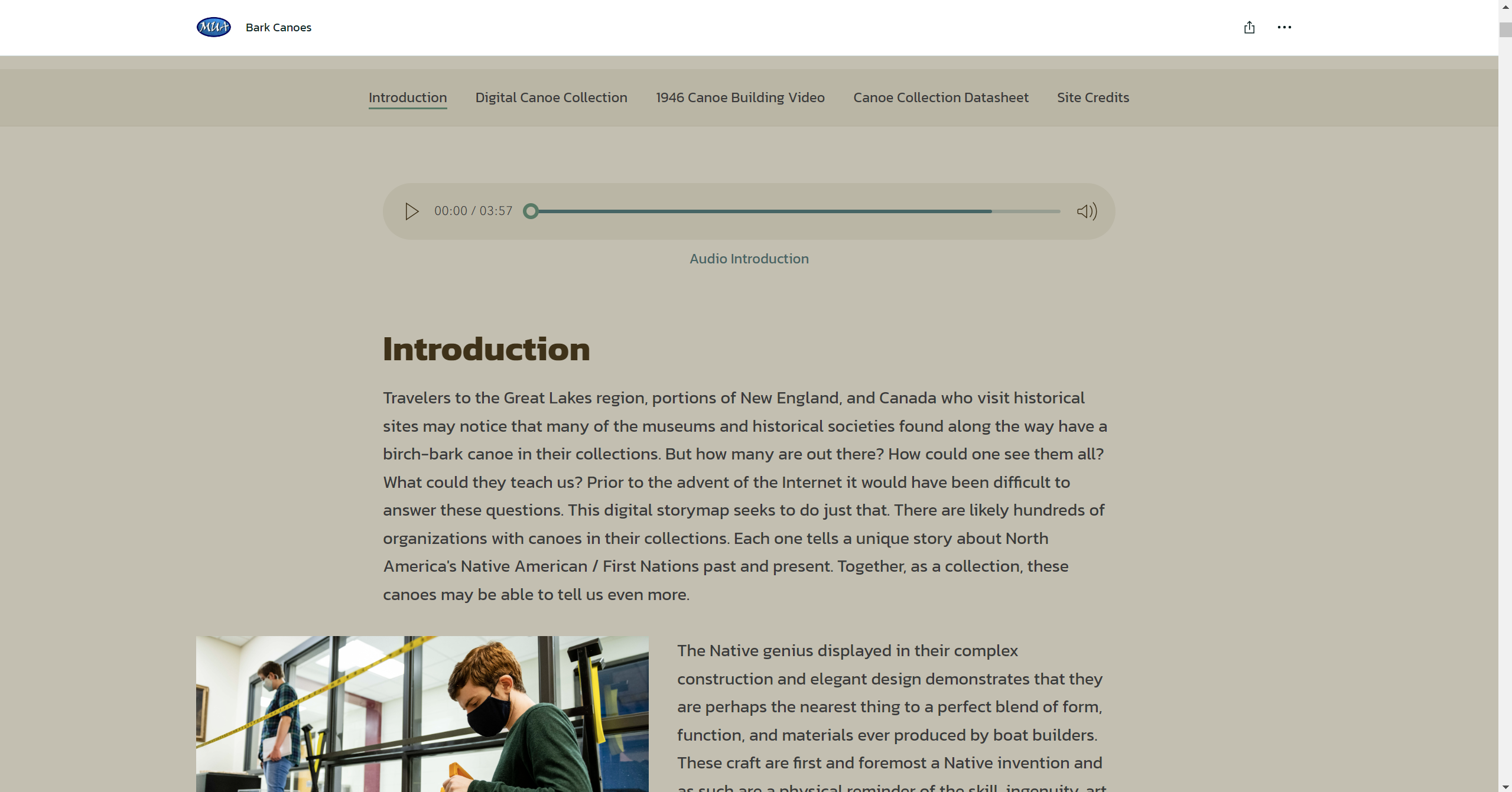
The introduction is so little bit weird as all of the text is pushed into the middle of the screen with a few images jutting out from the block of text into the empty side of the screen. There is much more space for the website to have more images or to spread out text to make it easier to look at and fewer lines to read down. The introduction also comes with a 4-minute audible reading which is a nice feature if reading isn’t your thing.
https://storymaps.arcgis.com/stories/899023e31da6401dae2bb50ebecbdff8
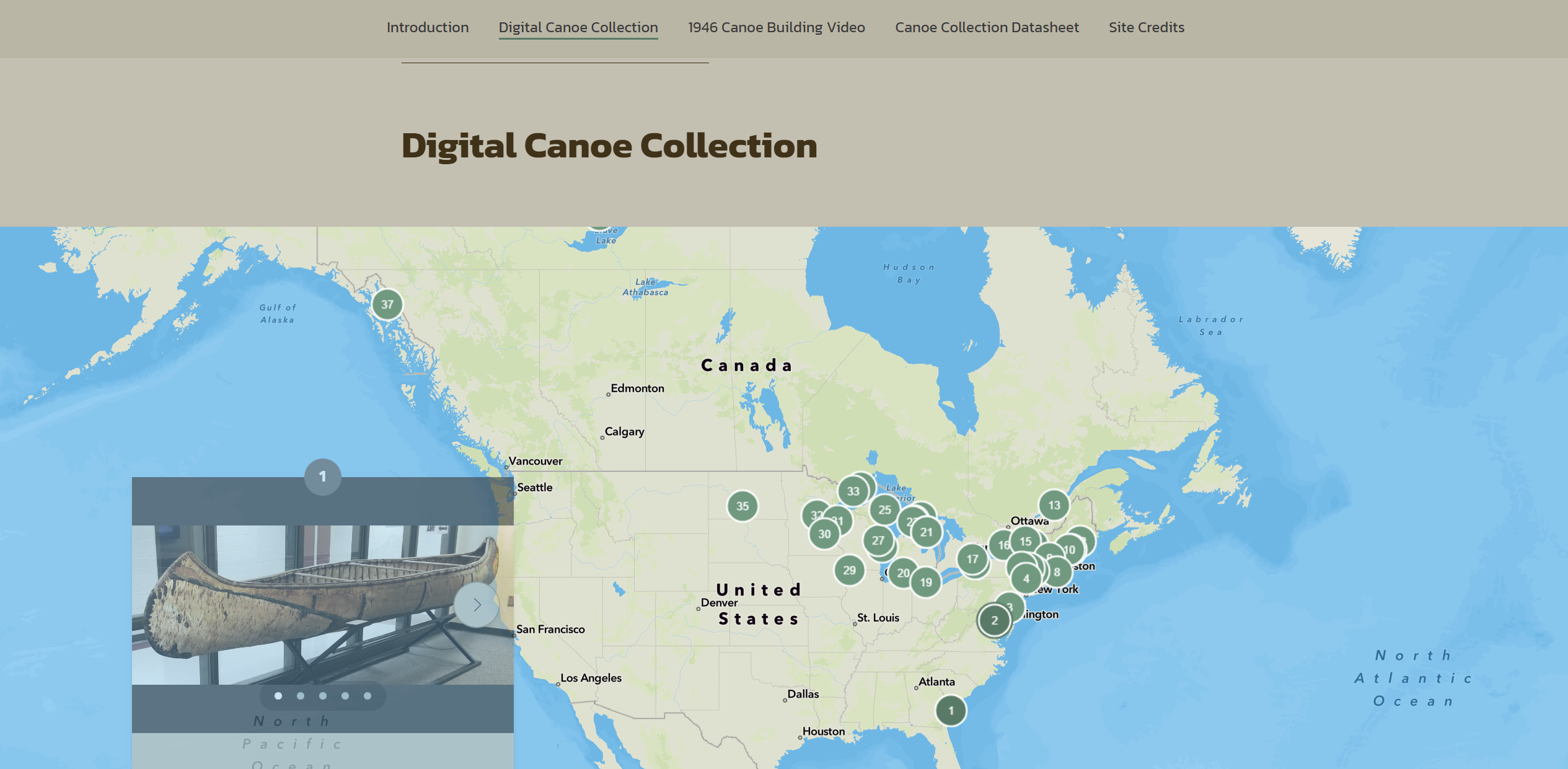
After the introduction comes most of the rest of the website, which is labeled as the “Digital Canoe Collection” on the heading. When you scroll down, you see a number followed by an image followed by a description of the canoe in the image, and a history explanation. These vary from a couple of sentences to long descriptions of the historical creation and use of these canoes. The numbers match the map on the right side of the website. Clicking on the numbers on the map scrolls you to wherever that number is on the website and acts as a shortcut. The same happens when you scroll on your pass numbers, the map will move to each number as you pass it. This map allows you to pan around by clicking and holding on your mouse and dragging, as well as buttons to zoom in, zoom out, and move to the number you have selected. When you pan around the map the text on the left side fades enough so you can still tell it’s there but it doesn’t get in your way while looking at the map. It comes back when you scroll or click on it. The map becomes slightly difficult to use when looking for specific numbers especially when zoomed out as most of the numbers are in northeastern North America. They are also white numbers on a dark green background outlined in white, yet can be hard to see as the white and dark green blend in with the light green background on the map.
https://storymaps.arcgis.com/stories/899023e31da6401dae2bb50ebecbdff8
Across the top of the screen, there is a bar that has 5 options, introduction, digital canoe collection, 1946 canoe building video, canoe collection datasheet, and site credits. Each of these options is available by scrolling down the page but these shortcuts make it easier and faster to find your place. If someone were to just be looking for the video, a quick click could bring you straight to it without any hassle. If I were to want to find a certain canoe that I was looking for and didn’t know where it resided, this website would make it a bit more difficult to find especially with the large amount of scrolling I would have to do. However, the amount of information on these canoes is extensive. Every single canoe has several pictures as well as where it was found, what year it was dated, who was believed to have made it, where it now resides, dimensions including width, length, and depth of hold, and varying descriptions of the canoes. Some canoes even have videos mixed in with the images for more information and a better look at the canoes. Every single canoe also has links to more information about them. These lead to museum websites that have even more in-depth information if you are particularly interested in a certain canoe. In the bottom left corner, there is a little transparent black bubble that has a fraction out of 37 on it which tells you which number you are on.

https://storymaps.arcgis.com/stories/899023e31da6401dae2bb50ebecbdff8
This helps navigate and know your place on the website. The coloration of the website is very fitting for what it is about. There is a light beige background and dark brown text which doesn’t contrast and is easy to read. There is one section of the website that takes you to a spreadsheet and that is the canoe collection datasheet. It brings you to a large google drive spreadsheet of all of the canoes featured on the website and more. This can be hard to navigate however control + f does work on this datasheet and it makes it easier to find what you are looking for.
Conclusion and My Thoughts
The website overall is very informative and does exactly what it intends to. There is more than enough text to describe the canoes in full detail and give a backstory. The design I find a little bit problematic as the entire website is one long page. This makes it more difficult to navigate if you were to only scroll, however the buttons on the page make this much easier to navigate. The numbers are hard to find as the map is clustered and they take some looking. The links going to separate websites make it a little bit harder to navigate and make people spend less time on the website. Something I find odd about this website is that there is a lot of dead space on the sides. In the introduction and everything past the collection, there is a large indent on both sides of the text. Maybe this was supposed to be space for ads, but now it just sits empty. The bars across the top scrolling down to the other sections save a lot of time and make it much easier to access those parts and more likely people will visit them. I think this website is intuitive, simple, and informative. While there are a few quirks to it, the website looks good and serves its purpose without much hassle.